
Premise
If you are not a Muslim, you may want to understand what Islamic source texts say about non-Muslims (kafirs). While it is helpful to understand what Muslims themselves say, it is more important to understand the three primary Islamic source texts: the Quran, the Sīrah, and the Hadith.
Inciting Incident
I recently had the opportunity to visit Turkey with some friends. Over the past 40 years, I have spent a total of a year and a half there and speak conversational Turkish. I love the people, culture, and cuisine of Turkey. While walking from the Eminönü ferry to the Egyptian Spice Bazaar in Istanbul on a bright Saturday morning, we passed the New Mosque (completed in 1663). As I have observed on many other occasions, older men were washing their feet, faces, and hands to prepare for prayer in the mosque. I wondered, What motivates these men to perform ritual washing and prayer five times a day?
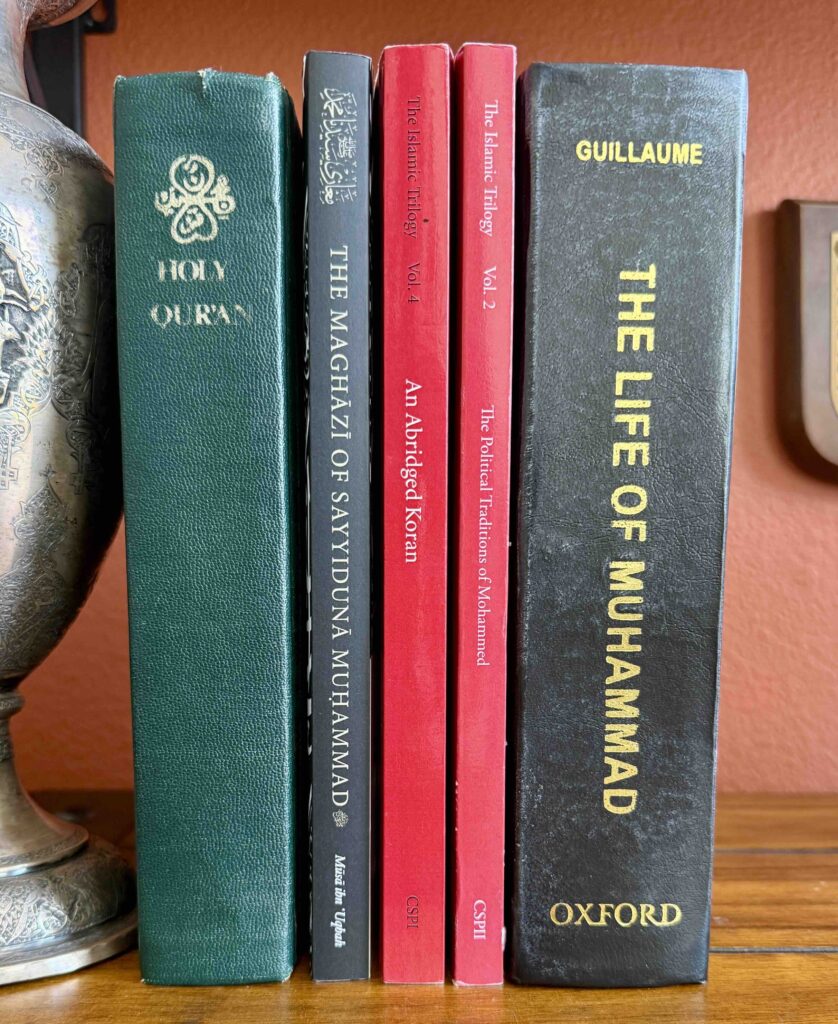
When I returned home, I began thinking again about Islam and its origins. I have taken a course on Islam, read the Quran once from beginning to end and then a second time in an abridged format, and participated in dozens of conversations with Muslims over the decades. In recent weeks, I have returned to studying the Quran, the Sīrah (the writings on the life of Mohammed), and the Hadith (the sayings of Mohammed). The header photo shows my source texts comprising 2,550 pages — of which I have read 2,000 pages.
Three Source Texts
When I first began to study Islam in 1986, I started with the Quran and basic Islamic history. It was not until I was introduced to the Center for the Study of Political Islam (CSPII) in 2019 that I learned how important the Sīrah and the Hadith are in addition to the Quran. The Quran is the compilation of verses “sent down” by Allah to Mohammed and is considered the most sacred text in Islam. The Sīrah is the biographical material related to Mohammed’s life, during which various verses were received. The Hadith is a collection of sayings of Mohammed that helps explain how Mohammed himself sought to live out this new religion.
Through the work of CSPII, I realized that the Quran is best understood in light of the other two sources. There are a variety of Sīrah and Hadith collections, but generally, the oldest are considered the most trustworthy.
Will You Investigate for Yourself?
To understand today’s world, it is important to understand what the Quran and Mohammed advocated. According to research published by CSPII, 51% of the material in the combined three texts addresses non-Muslims (kafirs). They conclude:
“It is the stated purpose of Political Islam to convert, subjugate, or annihilate all kafirs.”
Rather than accepting their conclusion at face value, I encourage you to investigate the source material for yourself.
The CSPII website provides 12 overview articles. They also offer three levels of books to help people engage directly with the source material. I recommend starting with the Level I books (A Two Hour Koran, The Life of Mohammed: The Sira, Sharia Law for Non-Muslims, and The Hadith: The Traditions of Mohammed). They range from 70 to 110 pages in length.
If you can only read one book on the topic, I suggest An Abridged Koran (204 pages). In it, CSPII founder Dr. Bill Warner helps make the meaning of the Quran more accessible by using chronology, categorization, and context. The verses are placed in chronological order, grouped by subject, and presented alongside material from the Sīrah (the life of Mohammed). After reading The Abridged Koran, I went on to study the Sīrah and the Hadith in more depth. I read all 690 pages of The Life of Mohammed (I. Ishaq, translated by A. Guillaume). I am currently working my way through the Sahih Bukhari Hadith on this website.
Conclusion
As you seek to better understand Islam, may you do so with both clarity and compassion. This exploration is not about the beliefs of individual Muslims, but an invitation to examine primary texts firsthand. Taking time to examine source texts can deepen your convictions, but it should also shape how you relate to people—with humility, respect, and a desire for meaningful conversation. Truth and love are not in tension; they are meant to be lived together. As my wife Shirin wrote in her book Muslims Next Door, the
majority of Muslims want to live their lives in peace, like you and me.
_______________________________